Thor vs Hercules: A Hammer, a Club and Two Kinds of Strength
Thor has to lift a cat. Heracles has to kill a lion. On paper the Greek hero gets the harder job. Then the cat arches its back, Thor barely gets one paw off the ground, and the story starts to look rather different.
| Comparison | Thor | Heracles |
|---|---|---|
| Family | Son of Odin | Son of Zeus and Alcmene |
| Recognizable weapon | Hammer | Club or bow |
| Opponent in this story | A serpent disguised as a cat | A lion immune to arrows |
Side by side: Thor and Heracles
Family
- Thor
- Son of Odin
- Heracles
- Son of Zeus and Alcmene
Recognizable weapon
- Thor
- Hammer
- Heracles
- Club or bow
Opponent in this story
- Thor
- A serpent disguised as a cat
- Heracles
- A lion immune to arrows
The cat that Thor cannot lift
In Snorri’s account of Thor’s visit to Útgarda-Loki, the host sets the thunder god a series of humiliating contests. Thor drinks from a horn he cannot empty, wrestles an old woman he cannot beat and struggles with a house cat. The trick is in what the host has shown him. The horn opens onto the sea. The woman is Old Age. The cat is the Midgard Serpent disguised.
One raised paw means Thor nearly lifted the serpent that encircles the inhabited world. The spectators had good reason to be scared. A reader who stops at the failed lift misses the joke: the giant’s household survives by keeping Thor from understanding what he is touching.
Why Heracles puts down his bow
Heracles is the Greek name; Hercules is the familiar Latin form. In the Library attributed to Apollodorus, he shoots at the Nemean lion and discovers its hide defeats his arrows. He drives it into a cave with two entrances, blocks one and closes with it. Strength matters, but first he has to change the conditions of the fight.
This is one of the labors imposed by Eurystheus. The man who gives the orders has so little appetite for the results that Heracles’ return terrifies him. That gap between the hero doing the work and the king claiming authority over it gives the labors much of their bite.
A god protecting a boundary, a hero working off a debt
Thor’s hammer repeatedly carries him to the edge of the gods’ world to confront giants. Heracles is the son of Zeus and the mortal Alcmene. A command from a mortal king can send him out to face an animal no local hunter can kill. Calling both men “gods of strength” makes it difficult to explain why one answers to Eurystheus at all.
Who would win in a fight?
No surviving story cited here stages that match. Give them a straightforward wrestling contest and you still have to choose which telling of each figure counts. A more interesting test is to swap their assignments. Heracles succeeds once he understands the lion’s defenses. Thor loses face because his host controls what he can know. Both stories give the reader something a list of feats leaves out: the rules of the room.
What happens when the serpent is real?
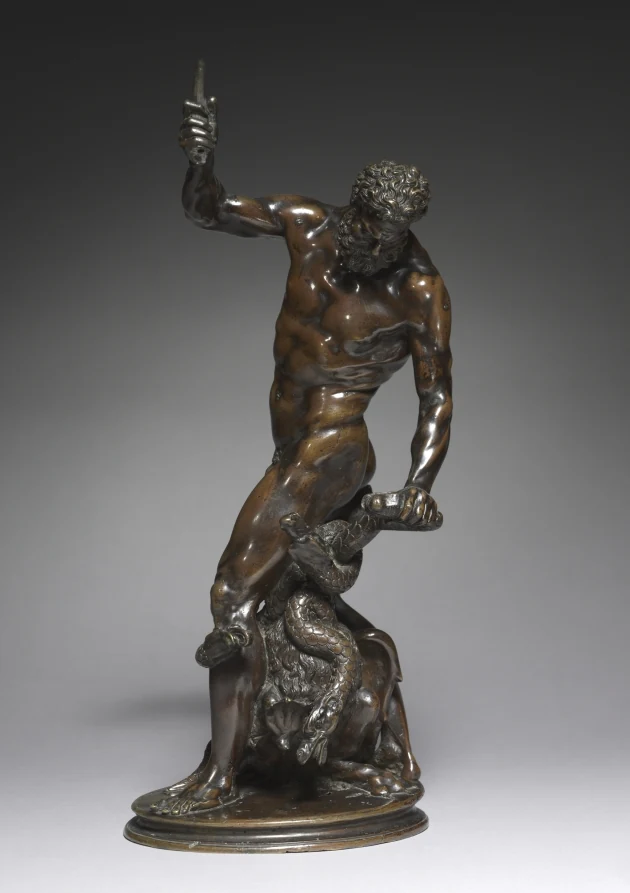
Thor eventually meets the Midgard Serpent without a giant disguising it. At Ragnarök, in Snorri’s account, he kills it, takes nine steps and dies from its venom. The figure under Hercules in the museum bronze above is a different monster altogether: the many-headed Hydra. That difference matters if you’re comparing how each fighter handles poison.
In the Library, Heracles needs Iolaus to burn the necks as he cuts off the heads that can grow back. Eurystheus later refuses to count the labor because the hero had help. Heracles still leaves the fight with something he didn’t have before: arrows tipped with the Hydra’s poison. For Thor, a serpent’s venom ends the story. For Heracles, it follows him into the next one.