Ares vs. Mars: What Greece and Rome Asked of a War God
A Roman farmer has a problem for the god of war. He needs the crops to grow, the livestock to stay healthy and whatever threatens his land to keep outside its boundary. Cato’s handbook On Agriculture even tells him what to say. Address the god as Father Mars and have a pig, a sheep and a bull led around the property.
Mars is the Roman counterpart of the Greek Ares. Both gods belong on a battlefield. Their differences come into focus when you ask who is telling the story. A soldier in Homer, a worshipper asking for self-control and a Roman landowner have quite different reasons to pay attention to a god who can do violence.
Ares gets wounded at Troy
In Book 5 of the Iliad, Diomedes has good reason to fear Ares. The god fights on the Trojan side and can kill a mortal at close quarters. Athena climbs into Diomedes’ chariot and gives him the chance no sensible soldier would ordinarily take. When Ares thrusts his spear, she deflects it. When Diomedes strikes back, she drives the weapon home.
Ares bellows, leaves the battlefield and complains to his father. Zeus has little patience for a son so fond of fighting. He still has him healed. A few moments are enough to show the privilege of an immortal warrior. Ares can cry out, go home and have the wound closed. The men fighting below him have to live or die with what a spear has done.
The Greek prayer that asks Ares for peace
Readers often remember Zeus’s rebuke as the Greek verdict on Ares. Another Greek text lets someone else speak. The eighth Homeric Hymn asks Ares for courage, then turns inward. The person praying wants strength to check an impulse toward violence and to live under peaceful laws.
That is a shrewd choice of listener. Someone who needs help mastering a temper could turn to the god who knows what a fight feels like from the inside. Read the hymn beside the Iliad and the evidence gets more interesting. The poem about Troy shows the damage Ares can suffer and cause. The prayer asks whether some of that force could be put under human control.
Mars protects the farm boundary
Cato’s farmer is precise about what he wants protected. The prayer in chapter 141 names crops and vines, herdsmen and animals, the household and the land itself. It also asks Mars to keep off sickness whether its cause can be seen or not. The offering takes the boundaries of the property seriously enough to trace them on foot.
The ritual explains why calling Mars a war god can feel too small. A person who asks for military protection wants danger kept beyond a line. The farmer has a line of his own. He wants to gather a harvest inside it. Cato gives him a way to describe the things he values, down to individual plantings, to the god he trusts to guard them.
Why the Romans called him Father Mars
Roman tradition made Mars the father of Romulus and Remus. Ovid opens the March book of his Fasti by inviting the armed god to set down his shield and talk about the son who founded Rome. It is a striking way to begin a month named for Mars. The poet wants a family story from someone perfectly equipped to give a battle report.
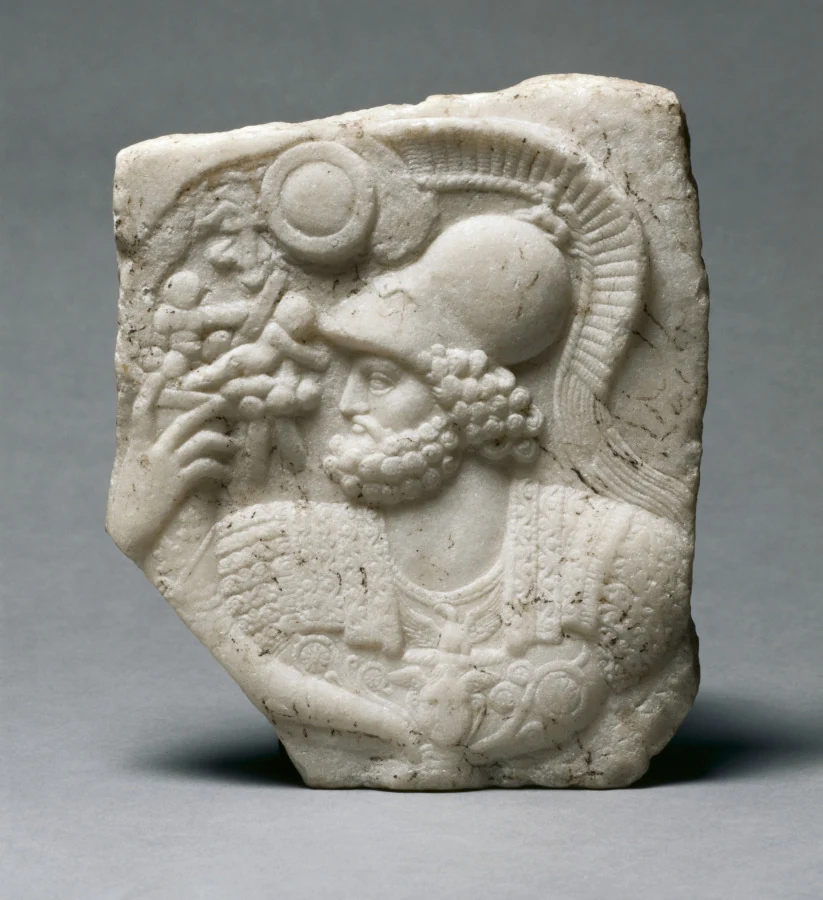
A Roman could encounter still another title, Mars Ultor, meaning Mars the Avenger. The relief pictured here puts a face and a crested helmet to that name. Each title tells you what someone wanted to remember about the god. Read Cato for the guardian of the farm, Ovid for the father, and Homer for the awful sound a war god makes when a spear finds him.
More from the Myth Library
Frequently asked questions
Is Mars the father of Romulus and Remus?+
Yes, in the Roman foundation story Mars fathers the twins with Rhea Silvia. Romulus goes on to found Rome.
Was Mars also a god of agriculture?+
Roman farmers could call on Mars to protect land, crops and animals. Chapter 141 of Cato’s On Agriculture preserves the words of one such prayer.
Did the Greeks only see Ares as violent?+
The Iliad shows his appetite for fighting, but the Homeric Hymn to Ares asks him to help the worshipper restrain aggression and live in peace.